Possession games for football training: how to set them up and progress them
By Marco Baleato · · About the author
A possession game is simple: one team keeps the ball, the other tries to win it, inside a marked area. It is one of the most used formats in football training because it trains passing, support, body shape and pressing at the same time, with the decisions of a real match.
It is not the same as a rondo. In a rondo the players in possession stay on the outside of the square and the defenders work in the middle. In a possession game everyone moves inside the area, so players also have to find space, open up and help a teammate who is under pressure.
Four things you decide before you start
Space. A 4v4+3 works well in 25 × 20 m. A bigger area gives time to think and to switch the play; a smaller one adds pressure and forces quick touches.
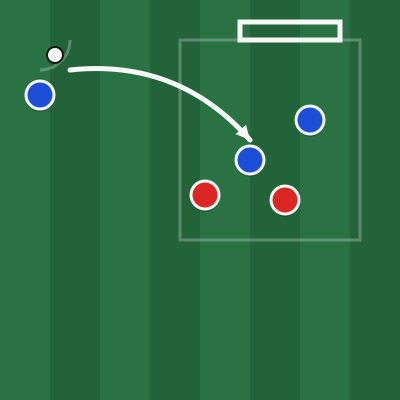
Numbers. Even teams (4v4, 5v5) make winning the ball realistic. Neutrals, who always play with the team in possession, create an overload: the ball keeps moving and less experienced groups can still string passes together.
Scoring. Count consecutive passes, give a point for every 8 or 10 passes, or reward a specific action, such as a switch of play or a pass to the third man. Players do what earns points.
Work and rest. Keep the blocks short, 2–4 minutes, with a pause to drink and correct. In a long block the quality drops and the game turns into a run.
Possession games by age
U9–U12: start with the ten passes game, where nobody can pass back to the player who just passed to them, and the 2v2 with wall players, which teaches pairs to support and to defend together. The 4v4+3 comes next, with plenty of overload to keep the ball moving.
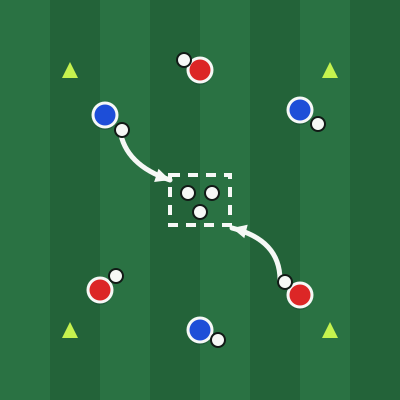
U13–U16: add touch limits and a purpose. The 5v5+2 two-touch game rewards the third-man combination, three-corridor possession teaches players to keep someone wide on each side, and the three-team game, where the team that loses the ball has to defend, trains the reaction after losing it.
U15 and older: link possession to the team's real shape. In the 7v7+1 each team keeps its positions and has to move the ball through both halves. With the right work-to-rest ratio, the 4v4 intervals also replace running for endurance.
Possession with a direction
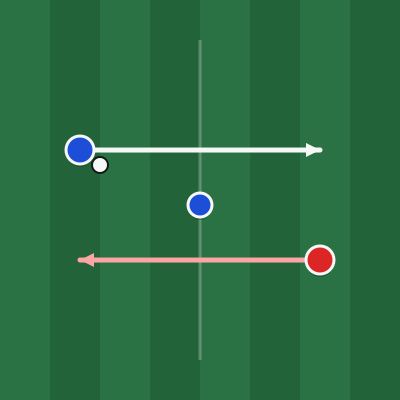
Keeping the ball is not the goal in a match: it is a way to find the moment to go forward. Once the group can keep the ball, give the game a direction. In possession to end zones, a point counts when a player runs into the end zone and receives a pass there. In the three-zone switch game, the team draws the opponents to one side and scores by switching to the far zone.
These games connect possession with what happens next: the forward run, the switch and the attack on space.
How to make it harder or easier
Harder: smaller area, fewer neutrals, a two-touch or one-touch limit, or a time limit to reach the passes.
Easier: bigger area, an extra neutral, free touches, or a defender who can only intercept and not tackle.
Change one thing at a time and watch for a few minutes. If the defenders never win the ball, it is too easy; if possession never lasts more than three passes, it is too hard.
Put it in a session
A possession game fits in the main part of almost any session, after a rondo in the warm-up and before a match. In the session planner you can choose “Keep possession” as the tactical objective, and it suggests the tasks that fit your number of players and age group, with the minutes already distributed.