How to structure a football training session
By Marco Baleato · · About the author
A session is not a list of drills we like. It is a 60–90 minute journey with a beginning, a middle and an end, where each task prepares the next one.
The classic structure has three parts: warm-up, main part and cool-down. But before choosing any task, decide what you want to improve that day.
Objectives first
Session objectives are split by type: technical, tactical and physical. You do not need to set all three. You can focus on just one or combine several, depending on what your team needs that day.
Make them concrete. Technical: “improve the directional first touch”. Tactical: “keep the ball and progress towards the opponent's goal”. Physical: “work on reaction speed”. “Improve our play” is not an objective.
Then choose the tasks with those objectives in mind. The warm-up already touches them with the ball, the main part works on them in situations that get closer and closer to a match, and the final game tests them with a rule that rewards them.
If a task has nothing to do with your objectives, keep it for another day. Players then repeat the same idea in different contexts, which is how they learn.
Warm-up (10–15 minutes)
It prepares the body and the mind. Start gently and raise the intensity little by little: joint mobility, movement patterns and, soon, the ball.
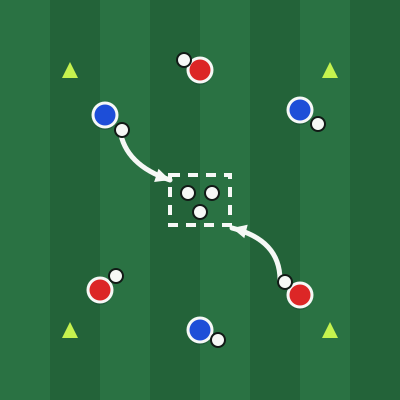
Typical tasks: passing patterns, simple rondos, reaction games and dribbling. With children, a game works better than a line of isolated drills.
Link it to the objective: if the day is about keeping the ball, a rondo or a passing warm-up already prepares what comes next.
Main part (40–55 minutes)
This is the centre of the session and where the objectives are worked on. Use two or three tasks, no more: every change of task costs minutes of explanation and set-up.
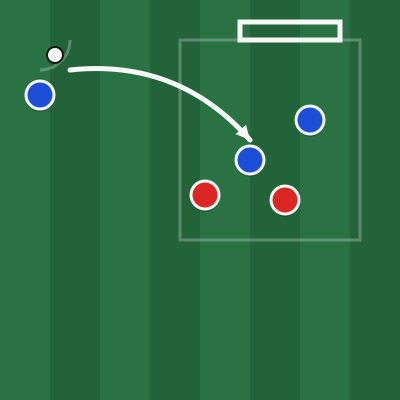
Order them from the simplest to the most match-like. For example: a technical task with little opposition, then a small-sided situation (2v1, rondo, possession) and finally a game with a rule that rewards the objective.
This is where intensity peaks. Work in 3–5 minute blocks with short breaks to correct and drink, and correct one thing at a time.
Cool-down (5–10 minutes)
Bring the heart rate down gradually: gentle passing, mobility or stretches. With children, a calm game with the ball works better than standing stretches.
Finish with a talk of a couple of minutes: what we worked on today, what went well and what we want to improve. It is the moment to review the objectives.
Example: 75-minute session for 14 players
Objectives: tactical, keep the ball and progress towards the opponent's goal; technical, passing and the directional first touch.
Warm-up (12 min): passing gates. In pairs, players pass through cone gates and look for a free gate after each pass.
Main part (53 min): 5v2 rondo with a split-pass bonus (15 min); possession game to end zones, where a point is scored by receiving inside the zone (18 min); and a 6v6 match with wide neutral players (20 min).
Cool-down (10 min): gentle passing circle and stretches, then the final talk.
Mistakes to avoid
Too many tasks: five or six different drills in an hour leave little real playing time.
Unrelated tasks: if each one works on something different, nothing improves in the end.
Long explanations and a final game with no rules. If you want to see the objective, add a rule that rewards it.
The RondoMap session planner splits the session into these three parts and suggests tasks for your objective, age group and number of players.