Small-sided games: how to choose the pitch size and number of players
By Marco Baleato · · About the author
Small-sided games are probably the most useful tool a coach has: players touch the ball a lot, they make real decisions and they enjoy it. But a 4v4 can train very different things depending on how you set it up.
Three variables decide what a game trains: the space, the number of players and the rules. This post explains how to adjust each one.
Space: more space, more time
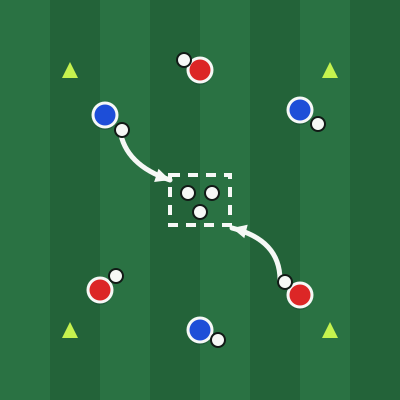
A useful reference is the area per player: divide the pitch area by the number of players. In the library, a 3v3 to four goals uses 25 × 20 m (about 80 m² per player), a 4v4 uses 30 × 25 m (about 95 m²) and the three-zone matches use 60 × 40 m for 16 players (150 m²).
Less space means more pressure, more duels and less time to decide: good for working on 1v1, receiving under pressure and pressing. More space gives time to build, to switch the play and to run in behind, and it raises the physical load in running.
The shape matters too: a long, narrow pitch favours playing forward; a wide pitch favours width and switches.
Number of players
Fewer players: more touches each and more participation. 3v3 and 4v4 are ideal for U7–U12 and for technical work at any age.
More players: the structure appears (lines, positions, distances between teammates). From 6v6 or 7v7, the game starts to resemble the match.
Neutrals (wildcards who always play with the team in possession) create a superiority that helps keep the ball and makes it easier for younger or less skilled groups.
Rules: the most precise tool
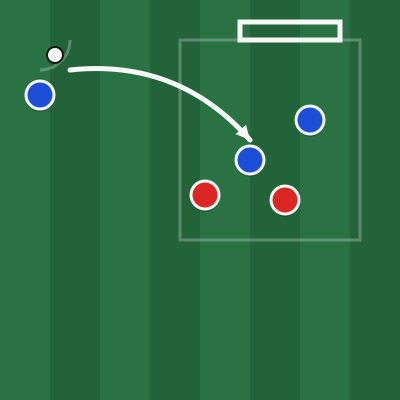
A rule changes behaviour without needing to explain it. Goals from crosses count double: the team looks for the wings. No pressing on the wings: the team learns to defend inside. Touch limits by zone: quick circulation in the build-up, freedom in the final third.
Change one rule at a time and watch for a few minutes before adding another. Too many rules and the players think about the rules, not about the game.
Work and rest
Small games are intense. Work in blocks of 3–5 minutes for 3v3 and 4v4, and longer blocks for bigger games, with active breaks: water, a short correction, change of teams.
With players left over, rotate them in every block or use them as neutrals, so nobody waits for long.