Crossing and finishing drills: how to attack down the wings
By Marco Baleato · · About the author
A cross is only as good as the runs in the box. Many crossing drills have one winger crossing to one striker with no defender, and the goal never happens on Saturday. To score from crosses, train three things together: how to get the ball wide, how to deliver it, and how to attack the box.
And adapt it to age: young players cannot yet lift the ball accurately into the box, but they can drive down the wing and cut it back.
Young players: the low cross
Up to U11–U12, teach the basic pattern: the winger runs into the space near the touchline, drives to the edge of the box and plays the ball low across the goal. Two players arrive, one at the near post and one at the penalty spot.
A 3v3 with wide neutrals, where goals from crosses count double, takes the same idea into a game.
Near post, far post
From U13 the strikers learn to share the box: one attacks the near post, one the far post, and a third arrives late at the edge for the cut-back. They arrive when the crosser looks up, not before, so they are moving into the ball.
The winger chooses the cross depending on where the space is: driven to the near post, floated to the far post, or pulled back. Then add defenders: in the 2v2 in the box, strikers learn to lose their marker and defenders learn to see ball and player.
Creating the cross
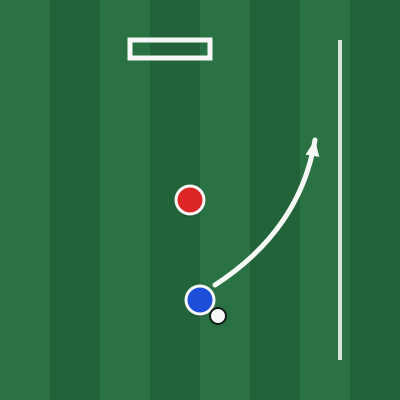
A cross does not appear on its own: the wide player has to beat a full-back or combine with a teammate. In the wing 1v1 the winger reads the full-back: if the line is open, go outside and cross; if the full-back shows them outside, cut in and shoot.
In the wing 2v1 the pair creates the cross with an overlap, a wall pass or a dribble, against a defender, while the strikers attack the box against a centre-back.
Take it to a match
Finish with a game where crosses matter. In “goals only from crosses” the whole team has to organise the attack around the cross: get the ball wide, free a player in the crossing zone and fill the box at the right moment. A 6v6 with wide neutrals is a softer version.
Count goals and crosses during the game. If there are many crosses and no goals, the problem is usually the runs, not the delivery.